 Add to Chrome
 Add to Firefox
 Add to Edge
Understanding LLM Evaluator Behavior: A Structured Multi-Evaluator Framework for Merchant Risk Assessment
Feb 04, 2026
Large Language Models (LLMs) are increasingly used as evaluators of reasoning quality, yet their reliability and bias in payments-risk settings remain poorly understood. We introduce a structured multi-evaluator framework for assessing LLM reasoning in Merchant Category Code (MCC)-based merchant risk assessment, combining a five-criterion rubric with Monte-Carlo scoring to evaluate rationale quality and evaluator stability. Five frontier LLMs generate and cross-evaluate MCC risk rationales under attributed and anonymized conditions. To establish a judge-independent reference, we introduce a consensus-deviation metric that eliminates circularity by comparing each judge's score to the mean of all other judges, yielding a theoretically grounded measure of self-evaluation and cross-model deviation. Results reveal substantial heterogeneity: GPT-5.1 and Claude 4.5 Sonnet show negative self-evaluation bias (-0.33, -0.31), while Gemini-2.5 Pro and Grok 4 display positive bias (+0.77, +0.71), with bias attenuating by 25.8 percent under anonymization. Evaluation by 26 payment-industry experts shows LLM judges assign scores averaging +0.46 points above human consensus, and that the negative bias of GPT-5.1 and Claude 4.5 Sonnet reflects closer alignment with human judgment. Ground-truth validation using payment-network data shows four models exhibit statistically significant alignment (Spearman rho = 0.56 to 0.77), confirming that the framework captures genuine quality. Overall, the framework provides a replicable basis for evaluating LLM-as-a-judge systems in payment-risk workflows and highlights the need for bias-aware protocols in operational financial settings.

Revealing the Attention Floating Mechanism in Masked Diffusion Models
Jan 12, 2026Masked diffusion models (MDMs), which leverage bidirectional attention and a denoising process, are narrowing the performance gap with autoregressive models (ARMs). However, their internal attention mechanisms remain under-explored. This paper investigates the attention behaviors in MDMs, revealing the phenomenon of Attention Floating. Unlike ARMs, where attention converges to a fixed sink, MDMs exhibit dynamic, dispersed attention anchors that shift across denoising steps and layers. Further analysis reveals its Shallow Structure-Aware, Deep Content-Focused attention mechanism: shallow layers utilize floating tokens to build a global structural framework, while deeper layers allocate more capability toward capturing semantic content. Empirically, this distinctive attention pattern provides a mechanistic explanation for the strong in-context learning capabilities of MDMs, allowing them to double the performance compared to ARMs in knowledge-intensive tasks. All codes and datasets are available at https://github.com/NEUIR/Attention-Floating.
SAFE-QAQ: End-to-End Slow-Thinking Audio-Text Fraud Detection via Reinforcement Learning
Jan 04, 2026Existing fraud detection methods predominantly rely on transcribed text, suffering from ASR errors and missing crucial acoustic cues like vocal tone and environmental context. This limits their effectiveness against complex deceptive strategies. To address these challenges, we first propose \textbf{SAFE-QAQ}, an end-to-end comprehensive framework for audio-based slow-thinking fraud detection. First, the SAFE-QAQ framework eliminates the impact of transcription errors on detection performance. Secondly, we propose rule-based slow-thinking reward mechanisms that systematically guide the system to identify fraud-indicative patterns by accurately capturing fine-grained audio details, through hierarchical reasoning processes. Besides, our framework introduces a dynamic risk assessment framework during live calls, enabling early detection and prevention of fraud. Experiments on the TeleAntiFraud-Bench demonstrate that SAFE-QAQ achieves dramatic improvements over existing methods in multiple key dimensions, including accuracy, inference efficiency, and real-time processing capabilities. Currently deployed and analyzing over 70,000 calls daily, SAFE-QAQ effectively automates complex fraud detection, reducing human workload and financial losses. Code: https://anonymous.4open.science/r/SAFE-QAQ.
TransactionGPT
Nov 12, 2025We present TransactionGPT (TGPT), a foundation model for consumer transaction data within one of world's largest payment networks. TGPT is designed to understand and generate transaction trajectories while simultaneously supporting a variety of downstream prediction and classification tasks. We introduce a novel 3D-Transformer architecture specifically tailored for capturing the complex dynamics in payment transaction data. This architecture incorporates design innovations that enhance modality fusion and computational efficiency, while seamlessly enabling joint optimization with downstream objectives. Trained on billion-scale real-world transactions, TGPT significantly improves downstream classification performance against a competitive production model and exhibits advantages over baselines in generating future transactions. We conduct extensive empirical evaluations utilizing a diverse collection of company transaction datasets spanning multiple downstream tasks, thereby enabling a thorough assessment of TGPT's effectiveness and efficiency in comparison to established methodologies. Furthermore, we examine the incorporation of LLM-derived embeddings within TGPT and benchmark its performance against fine-tuned LLMs, demonstrating that TGPT achieves superior predictive accuracy as well as faster training and inference. We anticipate that the architectural innovations and practical guidelines from this work will advance foundation models for transaction-like data and catalyze future research in this emerging field.
Legal$Δ$: Enhancing Legal Reasoning in LLMs via Reinforcement Learning with Chain-of-Thought Guided Information Gain
Aug 17, 2025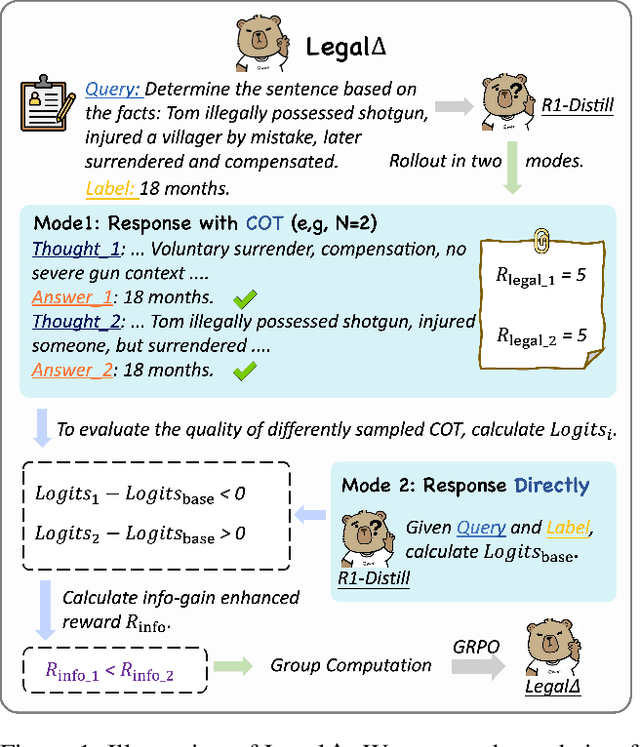
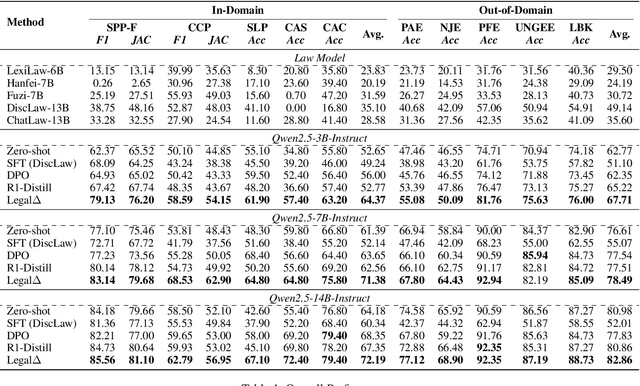
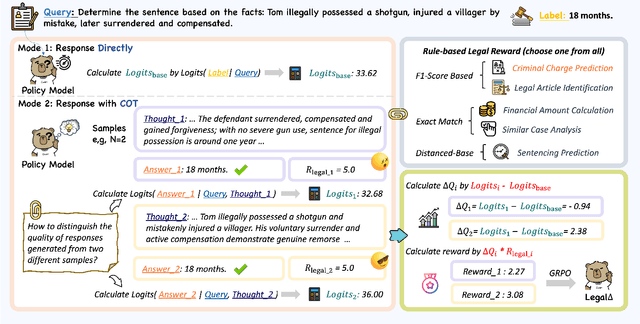
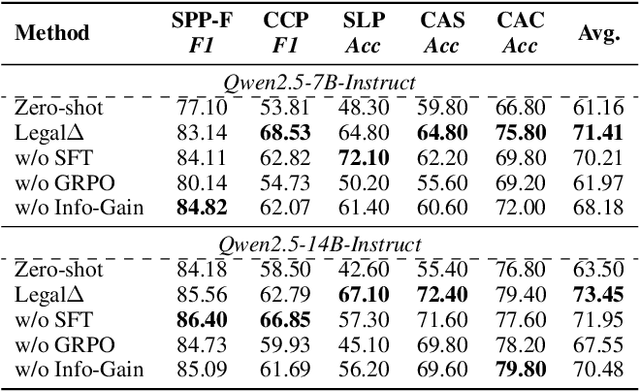
Legal Artificial Intelligence (LegalAI) has achieved notable advances in automating judicial decision-making with the support of Large Language Models (LLMs). However, existing legal LLMs still struggle to generate reliable and interpretable reasoning processes. They often default to fast-thinking behavior by producing direct answers without explicit multi-step reasoning, limiting their effectiveness in complex legal scenarios that demand rigorous justification. To address this challenge, we propose Legal$\Delta$, a reinforcement learning framework designed to enhance legal reasoning through chain-of-thought guided information gain. During training, Legal$\Delta$ employs a dual-mode input setup-comprising direct answer and reasoning-augmented modes-and maximizes the information gain between them. This encourages the model to acquire meaningful reasoning patterns rather than generating superficial or redundant explanations. Legal$\Delta$ follows a two-stage approach: (1) distilling latent reasoning capabilities from a powerful Large Reasoning Model (LRM), DeepSeek-R1, and (2) refining reasoning quality via differential comparisons, combined with a multidimensional reward mechanism that assesses both structural coherence and legal-domain specificity. Experimental results on multiple legal reasoning tasks demonstrate that Legal$\Delta$ outperforms strong baselines in both accuracy and interpretability. It consistently produces more robust and trustworthy legal judgments without relying on labeled preference data. All code and data will be released at https://github.com/NEUIR/LegalDelta.
Empowering Time Series Forecasting with LLM-Agents
Aug 06, 2025Large Language Model (LLM) powered agents have emerged as effective planners for Automated Machine Learning (AutoML) systems. While most existing AutoML approaches focus on automating feature engineering and model architecture search, recent studies in time series forecasting suggest that lightweight models can often achieve state-of-the-art performance. This observation led us to explore improving data quality, rather than model architecture, as a potentially fruitful direction for AutoML on time series data. We propose DCATS, a Data-Centric Agent for Time Series. DCATS leverages metadata accompanying time series to clean data while optimizing forecasting performance. We evaluated DCATS using four time series forecasting models on a large-scale traffic volume forecasting dataset. Results demonstrate that DCATS achieves an average 6% error reduction across all tested models and time horizons, highlighting the potential of data-centric approaches in AutoML for time series forecasting.
Towards Efficient Large Scale Spatial-Temporal Time Series Forecasting via Improved Inverted Transformers
Mar 13, 2025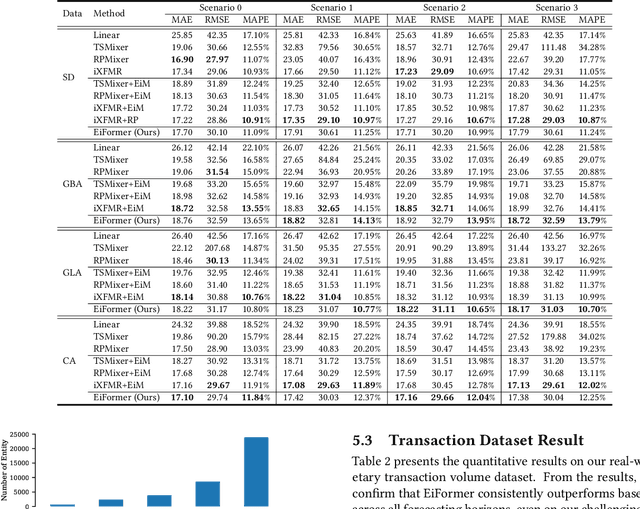
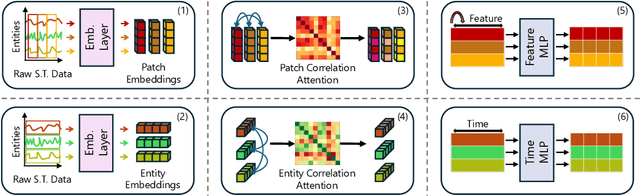
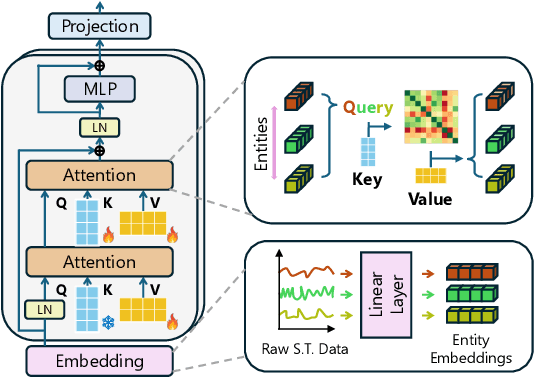
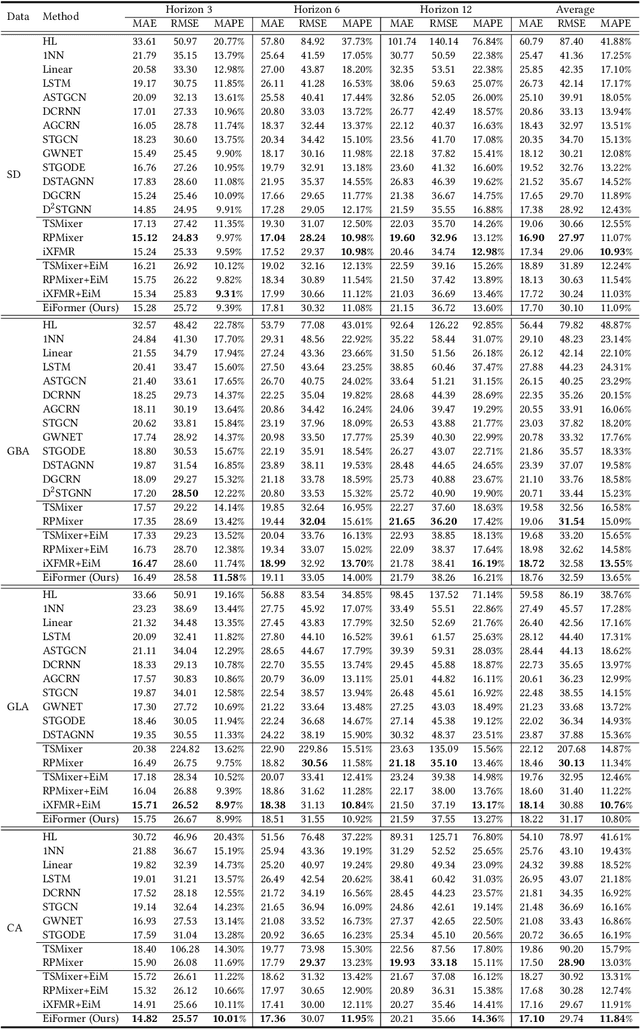
Time series forecasting at scale presents significant challenges for modern prediction systems, particularly when dealing with large sets of synchronized series, such as in a global payment network. In such systems, three key challenges must be overcome for accurate and scalable predictions: 1) emergence of new entities, 2) disappearance of existing entities, and 3) the large number of entities present in the data. The recently proposed Inverted Transformer (iTransformer) architecture has shown promising results by effectively handling variable entities. However, its practical application in large-scale settings is limited by quadratic time and space complexity ($O(N^2)$) with respect to the number of entities $N$. In this paper, we introduce EiFormer, an improved inverted transformer architecture that maintains the adaptive capabilities of iTransformer while reducing computational complexity to linear scale ($O(N)$). Our key innovation lies in restructuring the attention mechanism to eliminate redundant computations without sacrificing model expressiveness. Additionally, we incorporate a random projection mechanism that not only enhances efficiency but also improves prediction accuracy through better feature representation. Extensive experiments on the public LargeST benchmark dataset and a proprietary large-scale time series dataset demonstrate that EiFormer significantly outperforms existing methods in both computational efficiency and forecasting accuracy. Our approach enables practical deployment of transformer-based forecasting in industrial applications where handling time series at scale is essential.
A Compact Model for Large-Scale Time Series Forecasting
Feb 28, 2025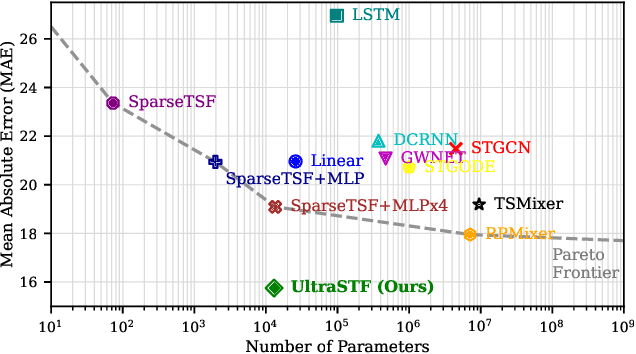
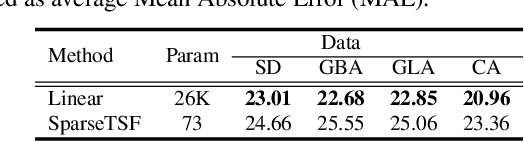
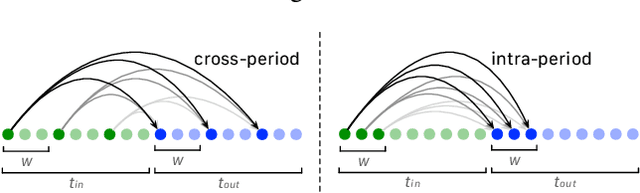
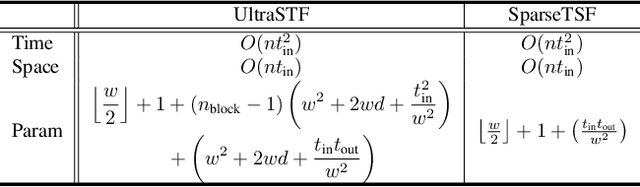
Spatio-temporal data, which commonly arise in real-world applications such as traffic monitoring, financial transactions, and ride-share demands, represent a special category of multivariate time series. They exhibit two distinct characteristics: high dimensionality and commensurability across spatial locations. These attributes call for computationally efficient modeling approaches and facilitate the use of univariate forecasting models in a channel-independent fashion. SparseTSF, a recently introduced competitive univariate forecasting model, harnesses periodicity to achieve compactness by concentrating on cross-period dynamics, thereby extending the Pareto frontier with respect to model size and predictive performance. Nonetheless, it underperforms on spatio-temporal data due to an inadequate capture of intra-period temporal dependencies. To address this shortcoming, we propose UltraSTF, which integrates a cross-period forecasting module with an ultra-compact shape bank component. Our model effectively detects recurring patterns in time series through the attention mechanism of the shape bank component, thereby strengthening its ability to learn intra-period dynamics. UltraSTF achieves state-of-the-art performance on the LargeST benchmark while employing fewer than 0.2% of the parameters required by the second-best approaches, thus further extending the Pareto frontier of existing methods.
Matrix Profile for Anomaly Detection on Multidimensional Time Series
Sep 14, 2024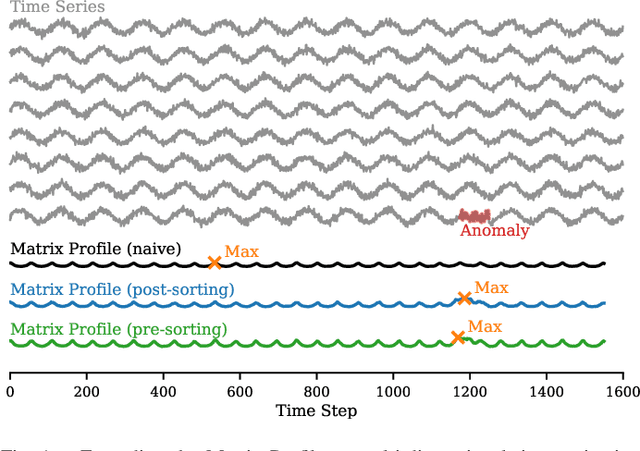
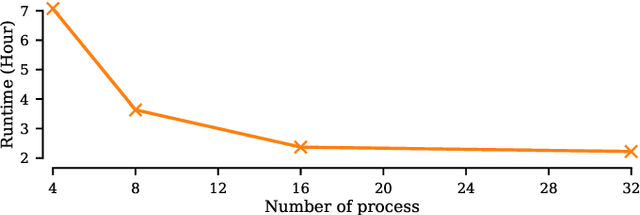

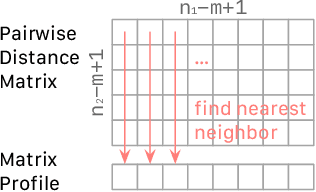
The Matrix Profile (MP), a versatile tool for time series data mining, has been shown effective in time series anomaly detection (TSAD). This paper delves into the problem of anomaly detection in multidimensional time series, a common occurrence in real-world applications. For instance, in a manufacturing factory, multiple sensors installed across the site collect time-varying data for analysis. The Matrix Profile, named for its role in profiling the matrix storing pairwise distance between subsequences of univariate time series, becomes complex in multidimensional scenarios. If the input univariate time series has n subsequences, the pairwise distance matrix is a n x n matrix. In a multidimensional time series with d dimensions, the pairwise distance information must be stored in a n x n x d tensor. In this paper, we first analyze different strategies for condensing this tensor into a profile vector. We then investigate the potential of extending the MP to efficiently find k-nearest neighbors for anomaly detection. Finally, we benchmark the multidimensional MP against 19 baseline methods on 119 multidimensional TSAD datasets. The experiments covers three learning setups: unsupervised, supervised, and semi-supervised. MP is the only method that consistently delivers high performance across all setups.
Preserving Individuality while Following the Crowd: Understanding the Role of User Taste and Crowd Wisdom in Online Product Rating Prediction
Sep 06, 2024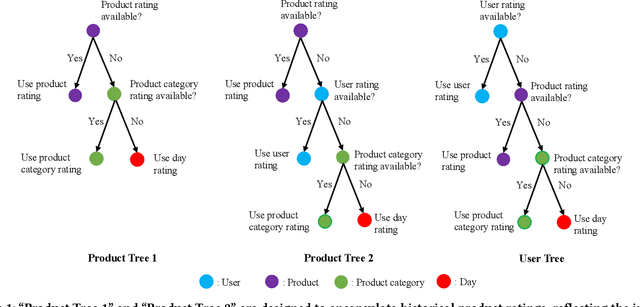
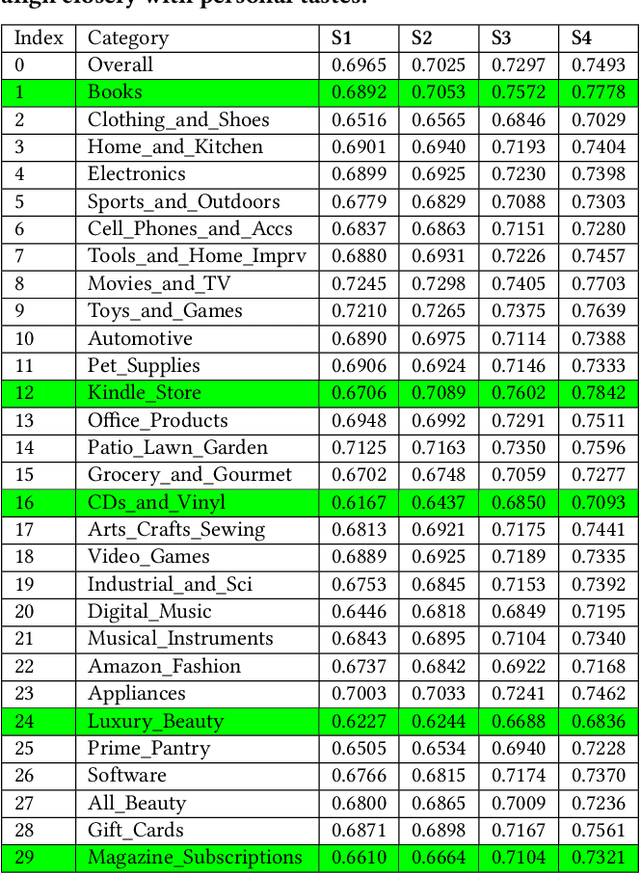
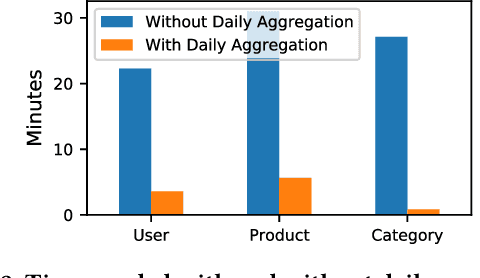
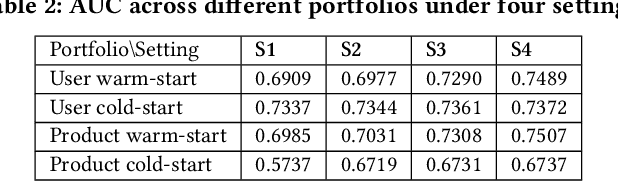
Numerous algorithms have been developed for online product rating prediction, but the specific influence of user and product information in determining the final prediction score remains largely unexplored. Existing research often relies on narrowly defined data settings, which overlooks real-world challenges such as the cold-start problem, cross-category information utilization, and scalability and deployment issues. To delve deeper into these aspects, and particularly to uncover the roles of individual user taste and collective wisdom, we propose a unique and practical approach that emphasizes historical ratings at both the user and product levels, encapsulated using a continuously updated dynamic tree representation. This representation effectively captures the temporal dynamics of users and products, leverages user information across product categories, and provides a natural solution to the cold-start problem. Furthermore, we have developed an efficient data processing strategy that makes this approach highly scalable and easily deployable. Comprehensive experiments in real industry settings demonstrate the effectiveness of our approach. Notably, our findings reveal that individual taste dominates over collective wisdom in online product rating prediction, a perspective that contrasts with the commonly observed wisdom of the crowd phenomenon in other domains. This dominance of individual user taste is consistent across various model types, including the boosting tree model, recurrent neural network (RNN), and transformer-based architectures. This observation holds true across the overall population, within individual product categories, and in cold-start scenarios. Our findings underscore the significance of individual user tastes in the context of online product rating prediction and the robustness of our approach across different model architectures.